

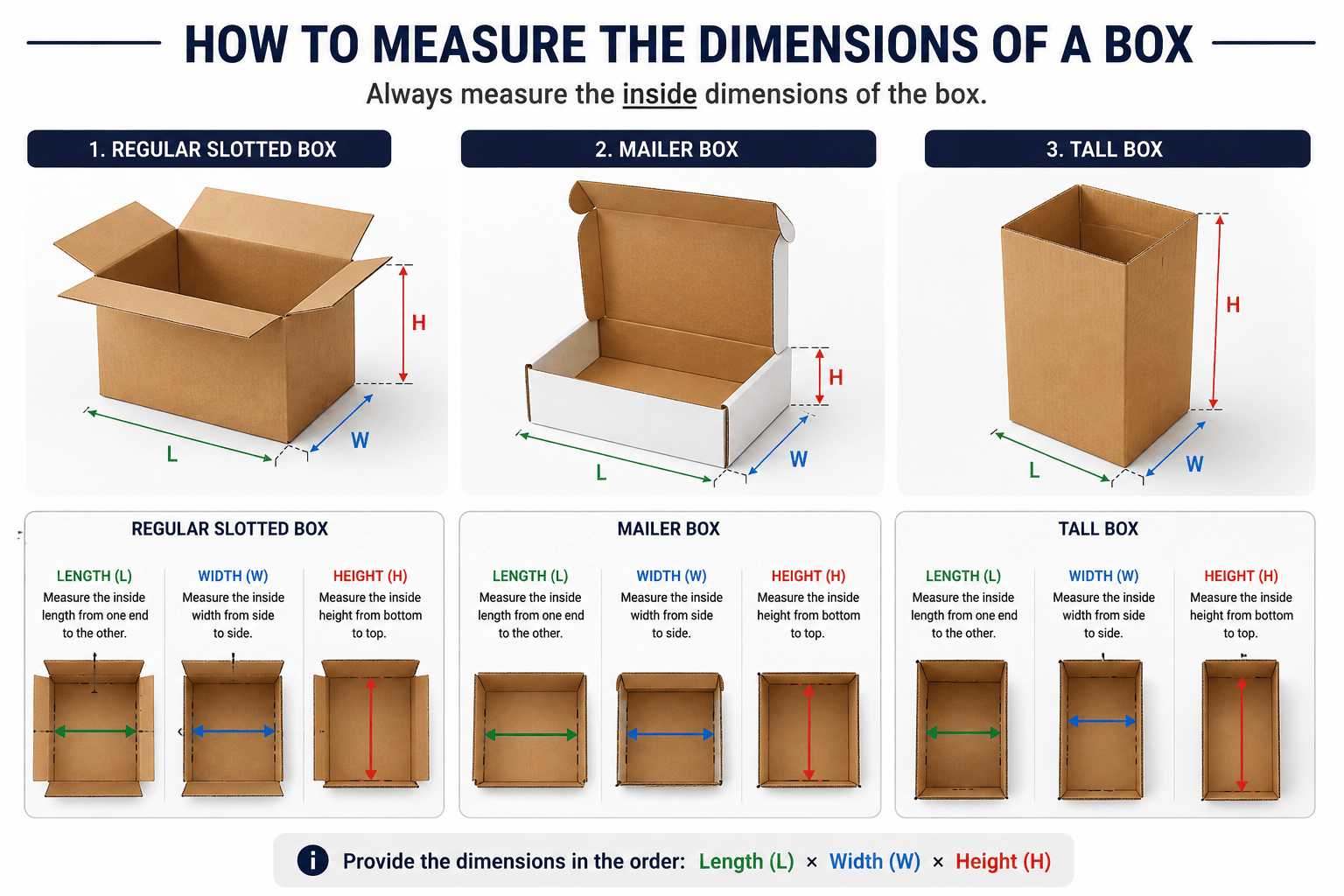
How to Measure the Dimensions of a Box
Measuring the dimensions of your boxes is a critical task of successful packaging. Whether you are making customized boxes, shipping boxes, or designing boxes for sale, if you don’t have the right size of box to hold your item, then your entire operation will suffer. Just think about how many times you have paid extra money for shipping, or had to replace a damaged item. That’s where proper measuring techniques come in.
In this article, we will discuss how to measure your box dimensions by teaching you the best method. We also explain it with some examples of various types of boxes, common errors to watch for, and helpful tips for getting the right measurements each time.
Why Does Measuring Dimensions Matter?
Each time you begin a new packaging project, it involves measurements. Right measurements help you:
· Save packing supplies
· Protect your products better
· Lower shipping costs
· Create accurate templates for die-cuts
· Print graphics with alignment
· Organize warehouse spaces
· Boost customer satisfaction
Making incorrect measurements typically leads to oversized boxes, excessive padding and damaged products. Sometimes it also increases the chance of redesigning the box.
What Are Your Box Dimensions?
Prior to measuring any type of packaging, it's good to understand the three basic dimensions used throughout the packaging industry:
Length (l): the longest side of the open end of your box.
Width (w): the shortest side of the open end of your box.
Height (h): the vertical space from the uppermost point of the open end down to the lowest point of the closed end of your box.
All dimensions must be in a particular order. This is always:
Length × Width × Height (l × w × h)
The Standard Method for Measuring a Box
The process for learning how to measure box dimensions begins by finding the open end of the box.
Step 1: Position the box properly
Place your box upright exactly like it will sit during shipping or storage. The open end of the box should be facing upward.
Step 2: Measure the length
Take a measurement of the longest side across the open end of the box. The length is always taken first.
Step 3: Measure the width
Now it’s the time to take the measurement of the smallest side i.e. width. This is called the width. Always measure from inside surface while taking internal Measurements.
Step 4: Measure the height
Start measuring from bottom of the box to its top. That is your height. Your last measurement should look something like this:
Length × Width × Height
Example:
12 × 8 × 4 inches
Do I Measure Internal Or External Dimensions of My Box?
There are two ways that packaging professionals like Custom Printed Boxes Canada measure them.
Internal dimensions
Internal dimensions give you how much usable space there is inside the box. They help you determine whether a product fits into the box correctly. Most custom packaging manufacturers want internal dimensions because that is how much space there is available for products.
External dimensions
External dimensions tell you how big the outside surfaces of a completed box are. Shipping companies normally base their calculation of dimensional weight and freight costs on external dimensions. Make sure to check which type of measurement was required before placing an order with any custom packaging manufacturer.
Measuring Various Kinds of Boxes
Even though there isn’t anything magical about measuring various kinds of boxes, certain styles of packages may call for slightly different approaches.
· Corrugated Shipping boxes
Try to get inside measurements whenever possible. Inside Measurements give you the most Accurate information about how a product will fit.
· Folding cartons
You should take measurements after assembling your carton into its final configuration. It is pointless to take a measurement of a flat carton since that does not show you the actual interior space once it’s folded.
· Mailer boxes
When measuring a mailer box, measure the interior cavity. That makes sure products stay snug in place and won’t bounce around too much during shipping.
· Rigid boxes
You will need to measure rigid boxes very carefully since thicker boards reduce interior space. Remember to factor in board thickness when determining whether or not a product will fit.
Which Tools Should You Use To Take Measurements?
As a packaging professional, you need reliable tools for your work. Some popular options include:
· Steel measuring tape
· Digital measuring device
· Metal ruler
· Vernier calipers for smaller boxes
· Laser measuring tool for larger packaging
Digital measuring devices provide greater reliability than analog devices and minimize variations in high volume packaging applications.
Common Errors Made In Taking Measurements
There are several common errors made by packaging professionals who aren’t careful enough when taking their measurements. Here are some common errors:
1. Measuring in the wrong order
Always begin with length. If you reverse the order, it will cause confusion among manufacturers. Always remember:
Length × Width × Height
2. Measuring on the outside rather than the inside
Measurement on the outside may not indicate the space available inside the product area. Unless you are planning on putting graphics on the exterior and not printing on an insert for your product, then internally is usually recommended.
3. Ignoring thickness of materials used
Thicker corrugated cardboard and rigid board reduce interior space available. Be aware of how thick your material is and subtract from total Measurements accordingly.
4. Taking Measurements off a flat package
No matter what type of packaging you plan to assemble into, flat packaging will never give you an accurate representation of usable internal space. Always take measurements off an assembled piece.
5. Rounding off Measurements too much
Small differences add up quickly in mass production.
Best Practices for Measuring Package Dimensions
Packaging professionals follow standardized measuring procedures to minimize errors in measuring. Consider the following best practices:
· Measure twice before entering the measurements into your records.
· Only utilize calibrated measuring instruments.
· Follow the Standard Length x Width x Height format.
· Measure assembled boxes whenever possible.
· Check your measurements again before you begin manufacturing.
Adopting and implementing standardized measuring techniques provides improved communication among packaging designers, manufacturers, and end-users.
Conclusion
Knowing how to correctly measure box dimensions is a vital component of a packaging professional's education. Correctly measured boxes promote product safety, decrease shipping expense, eliminate unnecessary materials, and increase manufacturing efficiency. There are two ways to measure. Measure the length, then the width and finally the height of your package. It is always important to check which type of dimensions was requested by your customer. Utilizing reliable measuring devices will also ensure precise and reliable measurements.