

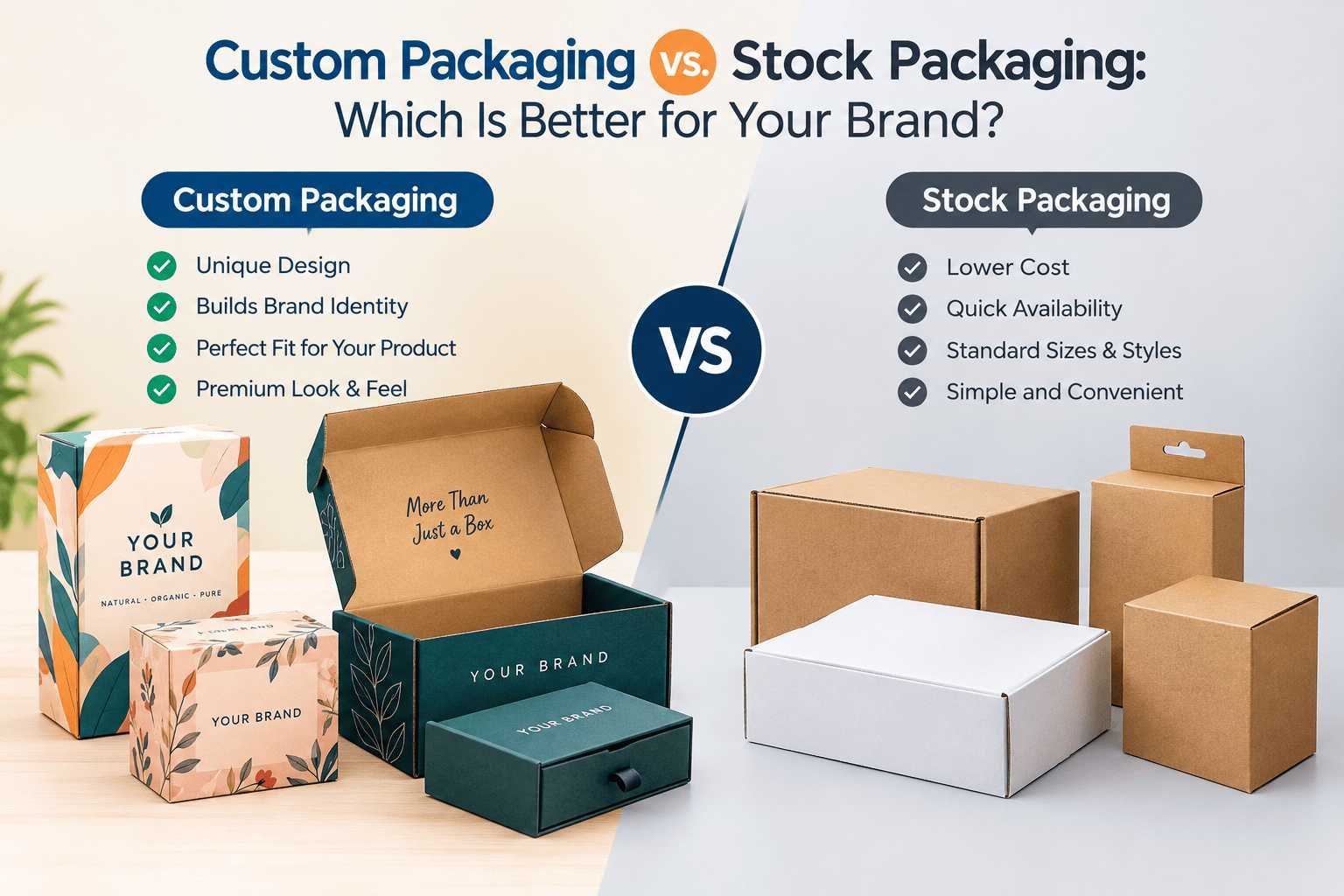
Custom Packaging vs Stock Packaging Which Is Right for Your Brand?
Packaging offers a protective covering for your product. A product's packaging provides insight to customers about the perception of the company and the product itself. There are generally two forms of packaging used frequently. They are stock packaging and custom packaging.
Stock packaging is made by manufacturing companies using standardized designs, materials, dimensions and shapes. On the other hand, Custom Printed Boxes have been created specifically for a particular brand's product with options for customized sizes, design, finishes and structural configurations.
Depending on the products being packaged, there are some advantages to each form of packaging. Thus, the appropriate option depends on the products being packaged, the cost associated with producing packaging for an order, the number of orders and ultimately the goals of the company's branding.
What is Stock Packaging?
Stock packaging represents re-made boxes that are manufactured in mass quantities in standard sizes and designs. These are available in bulk and are ready for immediate use.
Common Types of Stock Packaging
The most common types of stock packaging come in standard shapes, sizes and readily available materials. They include folding carton, mailers (mailer boxes), shipping containers (shipping boxes), rigid boxes, Kraft paper boxes, rigid boxes, bags, pouches and product sleeve boxes. Stock packaging is available in these general configurations for any business.
Benefits of Stock Packaging
Businesses that use stock packaging can expect fast delivery times and a quick answer to their packaging needs. It is comparatively less expensive than custom box packaging. With pre-made designs and standardized measurements, businesses do not have to spend a long time creating new structures for their packaging. Businesses that require minimal amounts of packaging at one time or those requiring immediate solutions benefit from stock packaging.
Limitations of Stock Packaging
The limitations of stock packaging are that there is very little room to be creative when it comes to design. The standard sizes available do not always fit perfectly around the products being packaged. This means some packages have empty space in them (which can lead to damage) and others have less than ideal protection. Additionally, there are far fewer ways to create unique presentations using stock packaging.
What is Custom Packaging?
Custom packaging is a personalized packaging to match your product or branding needs. It focuses on multiple aspects including size and box style variations, artwork and finishes.
For instance, a company producing skincare products may have custom-designed cosmetic boxes that match the exact size of every single product container (bottle). In addition, a food company may also have customized food containers with the proper sizes and graphics.
Custom packaging boxes can also contain various features such as inserts, windows, handles, magnetic closures, tuck flaps and compartments.
Custom Packaging Options
Custom packaging can be built around a product's size, shape and presentational needs. Options for custom packaging include versatile box styles in different dimensions, various material choices, printing, finishes, custom inserts and a variety of add-ons. The types of boxes available are folding cartons, mailer boxes, rigid boxes, corrugated boxes, Tuck End Boxes, Gable Boxes, Display Boxes and whatever style you need.
Custom Packaging vs. Stock Packaging: The Main Difference
The major difference when it comes to custom and stock packaging is flexibility. Custom packaging allows you to determine the size, shape, look and function of the box. Conversely, stock packaging offers fewer options but tends to be easier to obtain and use.
The main differences when comparing custom packaging and stock packaging are:
Size and Product Fit
Custom packaging fits around your product’s unique dimensions or shape. Stock packaging on the other hand, is typically offered in fixed sizes that will never perfectly match your product's unique dimensions.
Branding and Design
With custom packaging you have complete freedom as far as color selection, graphics, logos, and finish. With stock packaging, there are limited options for design and branding.
Product Protection
Custom packaging allows you to create the protective structure, insert, and materials specifically suited to protect your product. The protection afforded by stock packaging is general at best and does not always fit products that are fragile or uniquely shaped.
Cost
The initial cost associated with stock packaging is usually less than that of custom packaging due to its predetermined design and mass production.
Availability and Lead Time
Stock packaging is available immediately as it has been manufactured in standardized quantities. Due to manufacturing lead times required for customization, custom packaging takes longer to become available.
Shipping and Storage
You can have custom packaging created with your shipping and storage needs taken into account. Stock packaging may take up extra space in packages resulting in larger packages and more storage.
Shelf Appeal and Customer Experience
Due to the variety of designs and branding options available through custom packaging, you can create an aesthetically pleasing design and memorable unboxing experience. As for stock packaging, the presentation is simple with few personalized options.
Custom Packaging vs. Stock Packaging: Comparison Table
|
Feature |
Custom Packaging |
Stock Packaging |
|
Size |
Made to required dimensions |
Standard sizes |
|
Design |
Fully customizable |
Limited customization |
|
Branding |
Extensive printing options |
Usually requires labels or added elements |
|
Product fit |
Designed around the product |
Product must fit existing sizes |
|
Structural options |
Highly flexible |
Limited |
|
Initial setup |
May require design and development |
Minimal |
|
Availability |
May require production time |
Often readily available |
|
Best for |
Distinctive products and established packaging needs |
Simple, standard, or short-term needs |
Benefits of Custom Packaging to your Brand
Customizing your product presentation is one of the biggest benefits of custom packaging. You can choose colors, graphic styles, fonts, materials and finishes that correspond to your visual identity. Here are some of the other benefits you can avail:
Strong Brand Identity
Your brand identity is reflected in custom box packaging by applying your own color palette, graphics, typography and style. Using the same branding on all your packaging will create an easily recognizable brand image and distinguish your products from other unappealing packaging.
Better Product Fit
Custom printed packaging boxes allows for a better product fit in the package. A product that fits well inside has less room for movement. This reduces the amount of potential damage when being handled or shipped.
Consistent Packaging Across Product Lines
Another benefit of custom packaging includes having consistent packaging across all products. By using a similar style and design of box for each of your items, you are able to have a uniform look throughout all your different products. However, you can change only the size of the box and product description on each package.
Improve Customer Experience
A final benefit of applying a good design to the packaging of an item is that it improves the overall experience of the customer. When a product is properly packaged, it is much easier to unwrap, hold, and use.
Additionally, if the product has an attractive look, this can lead to creating positive memories for the customer as well.
Product-Specific Protection
The design of custom packaging can be specifically based on the exact dimensions (length x width) and shape. To minimize movement and protect the product from damage, inserts, strong materials, and customized structural configurations can be used.
When Is Stock Packaging The Better Option?
Stock packaging can be beneficial for businesses that want simple and convenient access to packaging. It is particularly effective when you have standardized product dimensions and don't require excessive customization for the packaging.
Startup companies and smaller businesses opt for stock boxes as they test out a product or have a limited budget for packaging. Since the packaging already exists, start-ups and small businesses would likely incur minimal costs associated with designing new packaging. The use of stock packaging is ideal for internal warehouse storage and shipping uses. It is also good for temporary packaging applications that don't have an urgent need to provide customized displays or presentations.
When Should You Choose Custom Packaging?
Custom Packaging is the right choice if you want to pack your products in a specific manner or if you want them to be highly protected. It also makes a good choice if you want to uniquely display your products. Additionally, creating an impact branding is possible with it. This may help make a better impression with customers than other types of packaging. This also creates a memorable unboxing experience.
Custom Packaging for E-Commerce
In ecommerce environments, we are constantly dealing with the challenges of product protection. They may come across many potential forms of damage including how they will handle multiple times, accidental shipping damages and impacts.
A good ecommerce business has to consider how to design the packaging to protect its products. Also, it tries to find ways to provide enough protection without creating so much bulk that it becomes difficult to ship. The ideal ecommerce package would have to provide both protection and efficiency in terms of shipping.
Product Protection During Shipping
The custom boxes we build can be made using the best available materials, designs and inserts to ensure products arrive undamaged. By providing a fitting product container, there is less chance of the contents shifting around which reduces the opportunity for damage.
Packaging Size and Shipping Efficiency
The goal of Custom boxes is to create a perfectly fitted container around each product. This minimizes wasted space within the boxes themselves and subsequently creates smaller, more manageable packages. This requires less effort for both shipping and storage.
Branded Unboxing Experience
Another element of custom packaging is the ability to provide customers with a memorable first impression. Custom packaging provides the business with the ability to establish color schemes, graphic design, texture and finish as well as structural elements for a great unboxing experience.
Does Custom Packaging Cost More As Compared to Stock Packaging?
Yes, custom packaging often costs more than stock packaging. These higher costs are dependent on numerous factors.
Factors That Affect Packaging Cost
Custom packaging pricing is influenced by several factors:
· Materials: Paperboard, Kraft, corrugated, rigid etc. are priced differently.
· Box Size: The larger the size of a custom box, the more material will be needed to build it, which increases its price.
· Box Style: A complex custom design or specialty style custom box typically has a higher cost than a simple design.
· Printing: Depending on how many colors do you print, what type of print process is used, and how much of the surface area of the box is printed on, this will increase the total cost.
· Finishing: Any finishing processes such as foil stamping, embossing, debossing, spot UV coating, or other types of laminations applied to the box in addition to printing will increase the final cost.
· Quantity: Larger quantities ordered at one time allow for bulk production and ultimately decrease the per-unit cost.
· Custom Inserts: Trays, dividers, and other protective inserts add both additional material and manufacturing costs to each custom package.
· Complexity of Artwork: There may also be design requirements such as creating complex artwork for your custom package or adding structural elements to your custom packaging design. It requires a manufacturer to invest additional time and resources.
Which is a Better Option for Product Protection?
Ultimately, either form of packaging may provide better product protection but it depends on your product.
As previously mentioned, you can design your custom packaging to select dimensions and structural features based on your product's shape, weight and fragility. It also provides you with the advantage of adding inserts, dividers or compartments to enhance the level of protection.
Stock packaging can provide adequate protection when there is a close fit between the available size/structure of the packaging component and your product. However, a box that is either too large or too small may not offer the same degree of fit.
Premium and expensive products require special protection or those having unusual shapes can benefit from creating customized boxes to provide optimal protection.
Which Packaging Creates Better Shelf Appeal?
Customized packaging offers you more opportunities to create a unique presentation of your products. You can choose among a variety of printing processes, finishes, textures and structural features to enhance the aesthetic appeal of your product.
Some potential options for enhancing shelf appeal include matte and gloss coatings, embossing and debossing, foil stamping, spot UV and custom windows etc.
In contrast, stock packaging generally does not allow for as much customization in terms of presentation. While it can appear professional, businesses have little control over the ultimate appearance of the finished product.
How to Choose a Right Product Packaging for Your Brand?
The process of choosing the right packaging includes evaluating your product's dimensional requirements and estimating your protection needs. Your branding requirements and budget also help you in making the right choice.
If you require specific dimensions and stronger product presentation along with uplifting your overall brand image choose custom packaging. If you need standard sizes and simple protection along with quicker availability choose stock packaging.
Many times a business will begin with stock boxes during the initial stages of testing out a product in a specific market. However, usually afterwards, businesses switch to Custom Printed Boxes to enjoy more personalization.
Frequently Asked Questions
Q: Is custom packaging more expensive than stock packaging?
A: Custom packaging typically will have a larger initial expense due to the fact that it requires custom materials, dimensions, design and production.
Q: Is custom packaging worth it for a small business?
A: Yes, it is worth as it protects the product well, present the product in a unique way and create customer recognition of your brand. A small business can begin with minimal changes to packaging and expand upon these changes as their volume increases.
Q: What is the difference between stock boxes and custom boxes?
A: Stock boxes are made by manufacturers in a variety of different standard sizes and designs before being shipped out to retailers. Custom boxes are manufactured at the request of the retailer, customized as per the needs of the product. Stock boxes provide limited options for sizes, structural components, and designs, whereas custom boxes allow for great flexibility in all three categories.
Q: Can custom packaging improve product protection?
A: Yes. As it can be tailored to fit your product's exact measurements so it enhances the level of protection. You can add protective inserts or additional materials to minimize movement.
Q: Can custom packaging reduce the empty space inside a packaging box?
A: Yes. Using custom boxes allows you to size them so that they fit your product exactly and therefore eliminates unnecessary empty space and excessive protective materials.
Q: What type of packaging is best for Canadian e-commerce businesses?
A: Your choice of package will depend on several factors such as the type of item you are selling, the condition during shipping and how much handling your item receives. Commonly used packages for e-commerce items include mailer boxes and corrugated boxes. They can be custom designed according to need.
Q: When should a business switch from stock to custom packaging?
A: Standard box packaging may be appropriate for small businesses with low order volume. But as your business grows, so does the cost of using these generic boxes, it is time to look into custom packaging options. Custom packaging provides you with the ability to create a unique, consistent brand image.
Conclusion
The choice as to whether a company should utilize stock packaging versus custom packaging is dependent on how much control and ease-of-use a company needs with its packaging. Stock packaging offers many benefits for companies in need of regular or temporary use of their packaging options, including quick access and cost-effectiveness. On the other hand, utilizing custom packaging gives you control to work on your desired design, size and function to depict your brand better.
Therefore choosing which type of packaging to use depends upon its objectives and your business needs.